


At ~S$14 billion, CapitaLand Investment is one of Singapore’s largest property giants. In 2021, it restructured its business — splitting its investment and development businesses
This Singapore dividend payer is well-managed. It produces consistent profits and dividends. And has a solid balance sheet.
At its peak, shares traded over S$4.
Yet since its reorganization, shares are now stuck going nowhere. What’s going on? And the bigger question…
Can shares ever hit its peak S$4.16?
CapitaLand Investment – What’s driving profits?
First things first, CapitaLand Investment is not easy to understand. As an ex-analyst, I found its business model complex to navigate.
Let me try to explain.
CapitaLand Investment’s business can be split into two profitable segments:

1. Fee-Income Business: The more profitable segment, which contributes ~62% of operating profits. CapitaLand Investment doesn’t own these assets. Instead, it manages these S$100 billion funds spread across listed, private and lodging funds.
In return, it collects a management fee.
This is the company’s core focus. And I find this a smart move.
Its pivot into an asset-light model mimics the Canadian’s Brookfield business model: Don’t own too many hard assets.
Instead, manage and collect recurring fees from these property owners.
This way, CapitaLand Invest builds a sturdy, fee-income business without using too much of its own capital – higher return on equity, lower debt and better scalability.
2. Real Estate Investment Business: CapitaLand Investment owns AND manages a portfolio of income-assets: retail malls, business parks, logistics hubs and so on.
It collects rental income.
As part of its strategy, it monetizes these assets, putting them into REITs, private funds or selling them to other property investors.
But if they are profitable…
Why shares of CapitaLand Investment keep falling?
Okay, here comes the tricky part.
When CapitaLand Investment sells its properties under the Real Estate Investment Business, it realizes a capital gain.
Without these properties, rental income drops.
However in return, it collects a lower, sturdier fee from managing these assets from the buyer.
Somehow, Mr. Market doesn’t like it.
You see, when CapitaLand Investment restructured a couple years back, investors expected big earnings.
After all, big restructuring comes with big expectations… Only to realize it’s a flaccid promise.
Since 2021, net profits have been lumpy.

The thing is, a pivot to an asset light model is long-term. The short-term dip in net profits will eventually be replaced with sturdier fee income.
I’d tolerate this as a dividend investor.
But it’s frustrating for Mr. Market.
What’s more, global real estate markets are still volatile, especially in China. And CapitaLand Investment has substantial exposure in. China’s real estate market is still recovering from a horrible debt crisis.
The weak property market has made it harder for Singapore’s blue-chip to divest assets in the world’s second largest economy. Last year, its China assets value fell.

Having said…
What I like about CLI – dividends still secured by good cash flow
I’ll tell you what I like about this Singapore blue-chip: CapitaLand Investment dividends are consistent enough.
In fact, over the last couple of years, it’s paid dividends of S$0.12 per share. Perfect for the dividend investor.
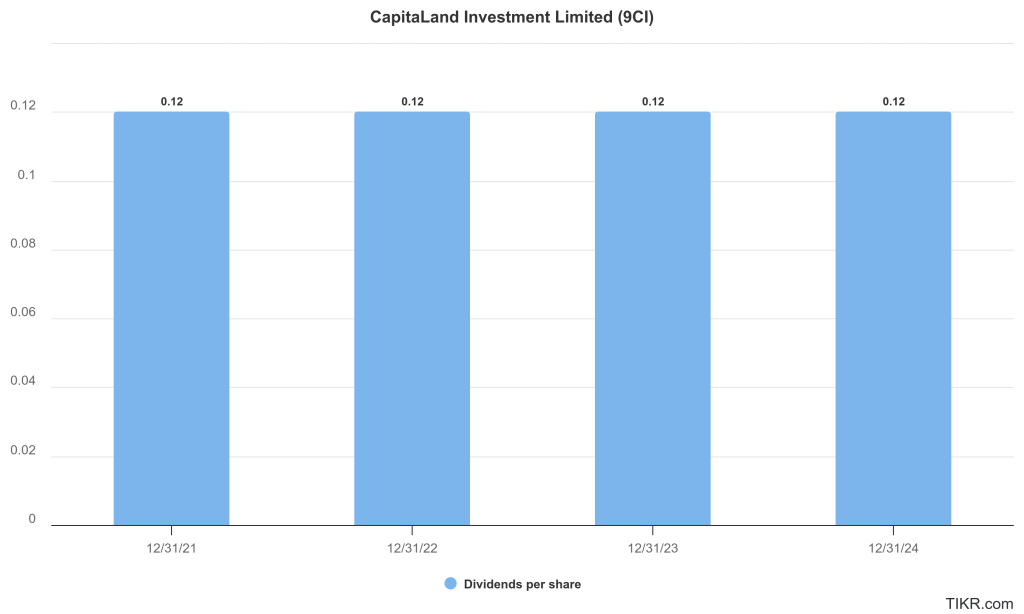
Today, shares trade ~4.2% yield. This doesn’t sound impressive at first.
But let’s understand that it’s a yield backed by owning and managing these assets – offices, retail malls, REITs, logistic parks and so on.
What’s more, CapitaLand Investment has kept gearing ratio low. As it moves into an asset-light model, it doesn’t have too much leverage. This is good.
It can tap on debt more readily if it wants to expand aggressively – new property fund launches, acquisitions etc. Its debt maturity profile is healthy, and doesn’t have major refinancing.

So… Can CapitaLand Investment ever hit S$4.16?
Two things must happen.
It needs to prove it can hit its target of S$200 billion funds under management by 2028. Today, CapitaLand Investment manages ~S$117 billion in funds. This means it must double FUM in just under three years.
Not impossible but very aggressive.

It needs to keep launching new funds organically and through acquisition. Last year, it acquired SC Capital and Wingate’s funds. Execution is key.
The bigger its funds management, the more fees it collects.
Here’s the other thing.
I’ve said before about CapitaLand Investment:
“This is CLIM’s Real Estate Investment Business (REIB). What’s that? Unlike their fee-income business, CLIM owns the properties in REIB.
CLIM works closely with property developers, buy out completed properties, then run the operations. The three big markets are China, India and Singapore. When the price is right, CLIM sells these properties for a fat profit. CLIM recycles profits back into new projects.
That’s what keeps the hamster wheel running.
Sometimes, you get good profits.
Sometimes, not so good profits.”
Unlike its fee-income business, the real estate business owns the assets.
When the market isn’t great, it’s hard to sell these assets for a good profit. As a result, you get pretty lump profits.
The good news is CapitaLand Investment is planning to launch CapitaLand Commercial C-REIT, a domestic-listed China REIT. This allows CapitaLand Investment to raise CNY capital and recycle its existing China assets into the REIT.
If it executes well, it becomes a new property recycling platform in China – develop, monetize and manage assets.
My final thoughts
CapitaLand Investment is not easy to understand. I like its pivot into an asset-light model, just like Canada’s Brookfield Corporation. In my view, CapitaLand Investment is moving the right track to build a sturdier, fee-income business.
This should support its 4.2% dividend yield today.
Now, can its shares go back up to S$4.16? Well, we must see an aggressive growth in funds under management and ability to consistently recycle its properties. I believe that’s what will drive future growth.
Sometimes, investing can be simple.
Willie Keng, CFA
Founder, Dividend Titan


Thanks for the deep-dive analysis on CLI which I also like about its asset like strategy and it steady, predictable fees & rental income. My only concern is CLI huge exposure in China property sector which yet to see any meaningful turnaround despite so-called 926 stimulus measures announced, made worse with the tariffs uncertainties. I’m doubtful whether the Capitaland Commercia C-Reit listing will pop as market response could be muted since Chinese consumers are hesitant about retail spending with economic & job uncertainties.
Hey Ian,
Thanks for your comments. Real estate operators like CLI have to compete in the global market, which is v competitive with big players like Blackstone, Brookfield, KKR and so on. Its China is one key piece, I’d also see its global presence too.
Cheers,
Willie